![HITV APP Download [Apk] Latest Version [Unlimited Movies]](https://hitvofficial.com/wp-content/uploads/2024/06/cropped-HiTV-Official-3.png)
How to Choose a Global Employer of Record: 7 Criteria That Actually Matter for IT Companies
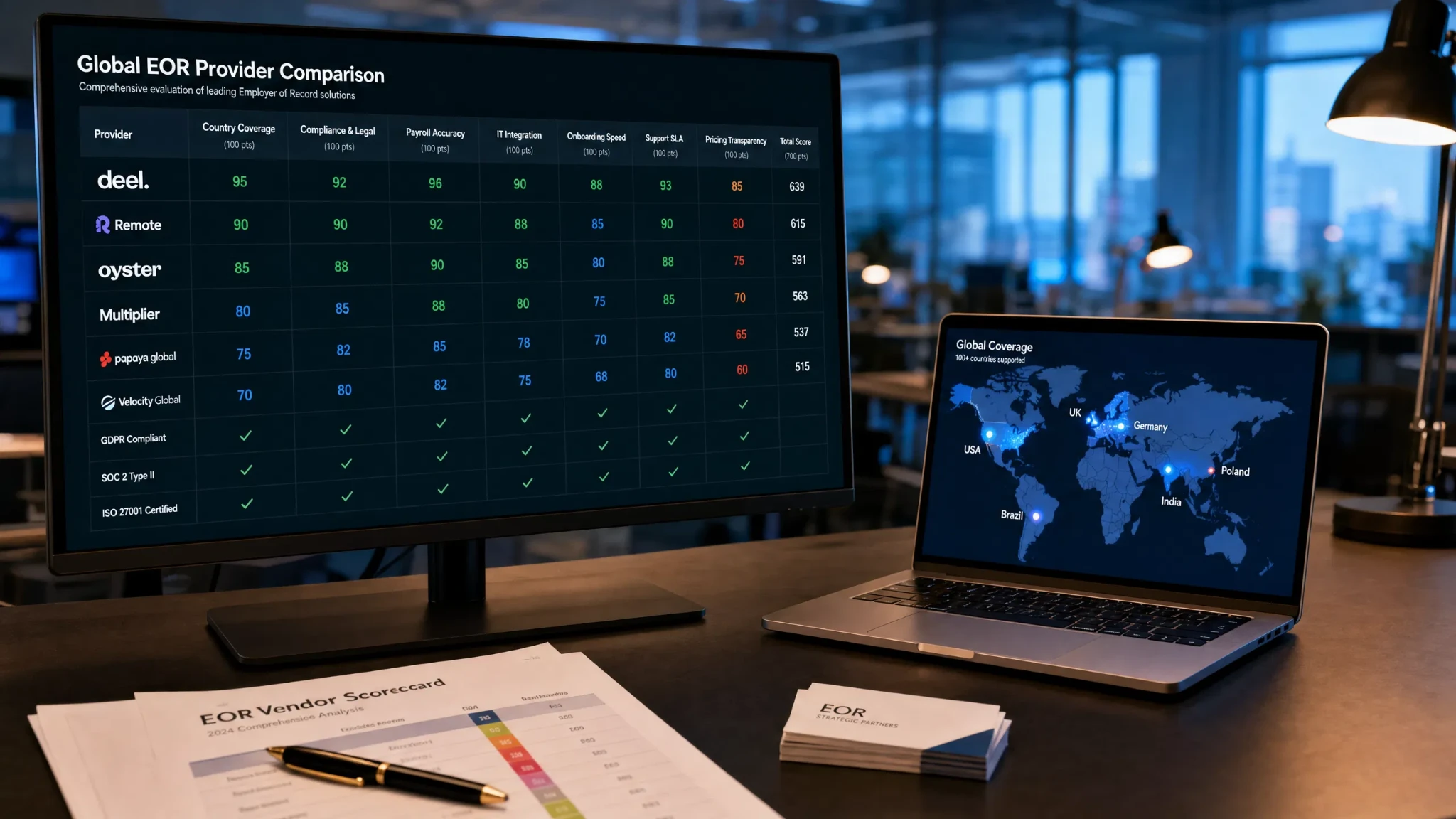
Scaling an engineering team across borders has never been simpler in theory and more operationally demanding in practice. IT companies today can identify the right candidate in Warsaw, Medellín, or Nairobi within days. What slows everything down is not the hiring decision; it is the legal and administrative infrastructure needed to actually employ that person. Setting up a local entity in every target country takes months and carries ongoing compliance obligations that consume significant internal resources. For companies that need to hire now and cannot afford to wait, this gap between hiring intent and legal readiness is a genuine competitive problem.
That gap is precisely what employer of record services are built to close. When evaluating which provider to work with, choosing the right global employer of record is not a procurement checkbox; it is a strategic decision that will shape how compliantly, how quickly, and how cost-effectively the company can grow its international engineering workforce. The criteria below are designed specifically for IT organizations, where talent profiles, IP sensitivity, and hiring velocity create requirements that generic EOR comparisons tend to miss.
What Is a Global Employer of Record?
A global employer of record is a third-party organization that legally employs workers on behalf of a client company in a foreign jurisdiction. The EOR becomes the legal employer of record in the local market, handling employment contracts, payroll processing, tax withholding, statutory benefits enrollment, and compliance with local labor law. The client company retains full control over the employee’s day-to-day work, task assignments, and performance management.
In other words, the EOR absorbs the legal and administrative complexity of cross-border employment so that the IT company can focus on building product rather than navigating foreign labor codes. This is materially different from a staffing agency, which supplies candidates. An EOR takes on ongoing employer liability for workers the client has already identified and decided to hire.
When Does It Make Sense to Use an EOR?
Here’s when a global employer of record can enter the game: when the hiring timeline is faster than the entity setup timeline, which in most jurisdictions means almost always for growing IT teams.
You should attentively analyze whether the following scenarios apply:
- Engineering roles need to be filled in markets where the company has no legal presence
- Remote hiring has expanded to multiple countries simultaneously, creating a patchwork of informal contractor arrangements that carry misclassification risk
- A key technical hire is located in a country with complex labor law, such as Germany, Brazil, or France, where employment terms require specific statutory protections
- The company needs to convert existing contractors to full-time employees to improve retention and reduce legal exposure
- Rapid headcount growth makes internal compliance management operationally unsustainable
The majority of IT companies that move to an EOR model report faster time-to-hire, reduced compliance overhead, and improved candidate experience, particularly for senior engineers who prefer the stability of an employment contract over a contractor arrangement.
7 Criteria That Actually Matter for IT Companies
Criterion 1: IT-Specific Talent Infrastructure
A lot of EOR providers operate as general employment services. For IT companies, this creates a practical gap: the provider may understand employment law in thirty countries but have no ability to assess whether a backend engineer’s skill set matches the role’s requirements. You should look for a provider that combines EOR services with a pre-vetted technical talent database and the technical assessment capability to screen candidates meaningfully.
GEOR, the global employment company operating as part of Geomotiv (theemployerofrecord.com), is built specifically around this requirement. The company maintains a proprietary database of over 40,000 pre-vetted IT professionals and has been sourcing and managing tech talent since 2010. Thanks to this foundation, GEOR can find qualified candidates up to four times faster than in-house HR departments or general recruitment agencies, which makes a material difference for engineering teams with urgent hiring needs.
Criterion 2: Country Coverage Depth, Not Just Breadth
A provider that claims coverage in 150 countries may be relying on a patchwork of third-party sub-vendors in many of those markets. What matters is not the number of flags on the website but the quality and consistency of employment infrastructure in the specific countries where the company needs to hire.
Pay attention to whether the provider operates through its own in-country legal entities or routes employment through local partners. Own-entity coverage produces more consistent compliance quality, faster onboarding, and clearer accountability when issues arise. GEOR maintains direct legal presence in five jurisdictions and provides reliable employment coverage across 180+ countries, combining direct operations with a carefully managed partner network.
Criterion 3: Onboarding Speed
For IT companies moving quickly, a six-week onboarding process is not acceptable. Candidates who have accepted an offer do not stay available indefinitely, and engineering project timelines rarely accommodate administrative delays.
What reliable EOR onboarding should have:
- Standardized, country-specific contract templates that do not require legal review from scratch for each hire
- Digital document collection and signature workflows
- Automated benefits enrollment where local law allows
- A defined timeline with accountability at each step
GEOR’s process is designed to bring new team members to a ready-to-work state within one to three days, which is among the fastest onboarding windows in the EOR category.
Criterion 4: IP and Data Security Protections
This criterion is specific to IT companies and often absent from general EOR comparisons. When engineers working under an EOR arrangement contribute to proprietary codebases, clear contractual assignment of intellectual property to the client company needs to be built into the employment structure from day one.
Apart from this, data security matters at the platform level. The EOR software used to manage contracts, payroll data, and employee records should meet recognized security standards. GEOR holds ISO certifications across three frameworks: ISO 9001:2015 for quality management, ISO 27001:2022 for information security, and ISO 45001:2018 for occupational health and safety. These certifications provide external validation of operational and security standards that IT companies should expect from any provider handling sensitive employment and compensation data.
Criterion 5: Transparent, Predictable Pricing
From a financial perspective, EOR pricing models vary enough to produce significant budget surprises if not evaluated carefully before contract signature. Per-employee per-month pricing is the most predictable structure and the easiest to model in workforce planning scenarios. Percentage-of-salary models can become significantly more expensive as compensation levels rise, which is particularly relevant for senior engineering roles where total compensation is high.
You should attentively analyze whether the pricing structure includes setup fees, country activation fees, offboarding fees, and costs for benefits administration. GEOR operates on transparent pricing plans that are published and accessible before any commercial conversation begins.
Criterion 6: Integrated Workforce Management Tooling
Managing a distributed engineering team through an EOR should not mean managing multiple disconnected tools. The EOR platform should provide time tracking, productivity visibility, payroll dashboards, and benefits management within a single interface. This reduces administrative overhead and gives team leads and HR a consolidated view of the distributed workforce without requiring manual reconciliation across systems.
What is also important here is that the platform should offer self-service access for employees to view payslips, manage personal data, and track leave, reducing the volume of HR queries that would otherwise be handled manually.
Criterion 7: Demonstrated Experience with Technical Clients
References from other IT companies carry more signal than general client lists. When evaluating a provider, ask specifically for case studies or client feedback from companies with similar technical profiles, headcount ranges, and target markets.
GEOR’s client base includes companies such as PebblePost, Savveo, and Pluto TV. David C. Peterson, CTO of PebblePost, described the engagement as follows: the GEOR team found highly skilled engineers to manage core project goals and supported the development of a scalable and reliable platform. This type of technical-context reference indicates that the provider understands not just employment law but the operational reality of building software products with distributed teams.
Conclusion
Choosing an employer of record for IT hiring is not primarily a legal procurement decision; it is an operational strategy choice that will affect how quickly engineering teams can be assembled, how securely IP is protected, and how well distributed employees are managed over time. First of all, IT companies should evaluate EOR providers against criteria specific to technical hiring, including talent infrastructure, onboarding speed, and IP protection, rather than relying on general EOR comparison frameworks. Secondly, the provider’s own tooling, certifications, and client references in technically demanding environments should carry more weight than country count or brand recognition alone.
Providers built specifically for IT workforce expansion, such as GEOR, bring a combination of employment compliance capability and technical talent operations expertise that general HR services companies cannot replicate. That combination is what makes the difference between an EOR relationship that enables growth and one that merely manages paperwork.